
SUSTAINABLE PROMOTIONAL PRODUCTS: WE WANT SOMETHING ECO-FRIENDLY, BUT NOTHING THAT FEELS PREDICTABLE
Updated: 1 day ago
“We want something sustainable.”
It's a brief we hear more and more often.
Then usually comes the second part:
“But we don't want the same eco promotional product everyone else is giving away.”
That's where the brief becomes interesting.
Because choosing sustainable promotional products doesn't have to mean automatically reaching for a natural coloured tote bag, bamboo pen or kraft notebook. Those products can absolutely be right for some campaigns, but sustainability is a much broader conversation than how “eco” something looks.
If this were our brief, we'd start somewhere else entirely.
We'd ask what you want the product to do.
Do you want something people will use repeatedly? Something made from recycled material? Something that replaces a disposable product? Something Australian-made? Something that can eventually be planted? Or perhaps something that starts a conversation precisely because recipients haven't seen it before?
Those answers would lead us in very different directions.
Option 1: Use Recycled Materials Without Making The Product Look Recycled
Option 2: If You Want The Material To Be The Conversation Starter, Lean Into It
Option 3: Rethink The Humble Promotional Pen
Option 4: Give People Something That Does Not Remain A Promotional Product Forever
Option 6: Make That Sustainability Feel Like A Gift Rather Than A Giveaway
There's Also A Big Difference Between "Looks Sustainable" And "Is A Good Sustainable Choice"
The Best Sustainable Promotional Product Might Not Look Particularly Eco At All

THE BRIEF
Objective:
Find sustainable promotional products that feel considered rather than predictable
Audience:
Broad business or event audience
Branding:
Professional and integrated into the product
Priority:
Sustainability needs to have a genuine connection to the product, but the merchandise should still be desirable in its own right
What we'd avoid:
Choosing something purely because it looks stereotypically “eco”
And that's an important distinction.
We don't think a promotional product becomes a good choice simply because it is brown, green or made from bamboo.
It still has to earn its place.
OPTION 1: USE RECYCLED MATERIALS WITHOUT MAKING THE PRODUCT LOOK RECYCLED
One direction we'd explore is merchandise that incorporates recycled materials but still looks polished enough for a professional environment.
Our Keilani softcover recycled leather notebooks (A5) are a good example.
They're made using recycled leather and currently start from $6.64. There is also a Keilani hardcover recycled leather notebook at the same starting price.
What we like about this direction is that the sustainability story doesn't have to dominate the visual identity of the product.
At first glance, it's simply a smart branded notebook.
That can be exactly right for a company that wants to make a more considered material choice without turning the promotional product into a sustainability statement in itself.
For conferences, employee packs, client meetings, workshops or corporate gifting, we'd rather choose a notebook people genuinely want to use and then let the recycled material become part of the story behind it.
That's very different from choosing an “eco notebook” because you feel you're supposed to.

OPTION 2: IF YOU WANT THE MATERIAL TO BE THE CONVERSATION STARTER, LEAN INTO IT
At the other end of the spectrum, sometimes the unusual material is exactly what makes the product interesting.
Our tree bark recycled paper notebooks (A6) currently start from $5.24.
This is the sort of product we'd consider when you actively want recipients to notice that their notebook is different.
It gives you a natural material story, but it also remains a functional product.
That's important.
Interesting materials can help promotional merchandise stand out, but novelty alone isn't enough. If the product still ends up unused, the sustainability message loses much of its value.
A notebook has an advantage because there is an obvious purpose for it.
The material gives people a reason to look twice.
The usefulness gives them a reason to keep it.

OPTION 3: RETHINK THE HUMBLE PROMOTIONAL PEN
Pens are one of the most traditional promotional products there are.
That doesn't automatically make them a bad sustainable choice.
In fact, when you're distributing hundreds or thousands of products, changing the material of something familiar can be an interesting direction.
The Odin recycled aluminium pens currently start from $1.57 and are available in custom colours.
This is where we'd potentially move away from the usual visual language of sustainable merchandise completely.
Instead of making the pen look deliberately earthy or natural, you could work with your own brand colour and allow the recycled aluminium construction to carry the sustainability story.
For us, that's much more interesting.
It demonstrates that sustainable promotional products don't all need to look the same.
And if you're going to choose a pen, we'd want to choose it because pens make sense for the audience and campaign, not simply because they're an inexpensive item onto which we can put a logo.

OPTION 4: GIVE PEOPLE SOMETHING THAT DOESN'T REMAIN A PROMOTIONAL PRODUCT FOREVER
This is one of our favourite directions when the brief is specifically asking for something different.
Instead of creating another permanent object, seed paper is designed to eventually disappear.
Our seed paper cards are made from recycled paper with seeds embedded into the material. Once the card has served its original purpose, it can be planted under a thin layer of soil and kept moist while the seeds germinate, with the paper eventually breaking down.
The cards are printed using water-based inks and currently start from $1.37 for the 100 x 70mm size.
That completely changes the promotional experience.
Rather than:
receive → use → keep
the journey becomes:
receive → read → plant → grow
And that gives you much more scope for creative messaging.
Imagine a sustainability campaign with a line about growing better ideas.
A company milestone with a message about what comes next.
A thank you card designed to become flowers.
A product launch built around growth.
A conference takeaway that attendees don't simply add to another pile of merchandise.
The product and the campaign message can become part of the same idea.
That's when promotional merchandise gets interesting.
OPTION 5: TAKE THE PLANTABLE IDEA FURTHER
If a simple seed paper card feels too minimal for the brief, we'd explore seed sticks.
Our seed stick greeting cards with 10 sticks currently start from $2.63 and combine a fully customised printed card with individual plantable seed sticks.
There are numerous flower and herb seed options available, including basil, chamomile, chives, lemon balm, parsley, thyme, carnation, English daisy, forget-me-nots, poppy and viola.
The printed component uses recycled board with soy- and vegetable-based inks.
Again, the appeal isn't simply that it's “eco-friendly”.
It's interactive.
Someone has something to do with it.
They open it, follow the instructions, wait for something to grow and potentially encounter your brand several times throughout that process.
Compare that with handing someone another object they didn't particularly need.
For the right campaign, we'd choose the interaction every time.
OPTION 6: MAKE THAT SUSTAINABILITY FEEL LIKE A GIFT RATHER THAN A GIVEAWAY
Not every brief involves 1,000 attendees.
If we were sourcing for a smaller group of clients, employees, speakers or stakeholders and had a larger budget per person, we'd change direction again.
One product we'd consider is the KEEPSEAKE herb planter.
These currently start from $28.93 and move the conversation away from conventional promotional merchandise entirely.
There's also the ceramic planter pot with bamboo base, currently starting from $10.73.
Products like these can work particularly well when the recipient relationship matters more than sheer distribution volume.
A planter sitting on someone's desk, windowsill or kitchen bench doesn't immediately read as “promotional merchandise”.
And sometimes that's precisely the point.
If the product fits naturally into someone's environment, your branding doesn't need to shout.

WHAT WE WOULDN'T DO
We wouldn't build the entire recommendation around the word eco.
That's too broad.
We'd want to understand what sustainability means within your particular brief.
If your objective is reducing disposable drinkware, we'd investigate reusable cups or bottles.
If recycled content matters, we'd look at recycled materials.
If you're trying to avoid creating another long-term object altogether, we'd look at seed paper or consumable products.
If longevity is the priority, we'd choose something genuinely useful that can remain in circulation for years.
And if your campaign is specifically about plants, regeneration, community or the environment, a growing product could make considerably more sense than simply choosing a recycled pen because it happens to sit in the eco category.
The story should fit the product.
And the product should fit the brief.
THERE'S ALSO A BIG DIFFERENCE BETWEEN “LOOKS SUSTAINABLE” AND “IS A GOOD SUSTAINABLE CHOICE”
This is where we'd encourage businesses to think beyond aesthetics.
A bamboo finish can look sustainable.
Kraft paper can look sustainable.
Natural cotton can look sustainable.
But the appearance of a product is only one small part of the decision.
We'd also think about material, intended lifespan, usefulness, quantity, packaging and what is likely to happen to the product after the campaign.
A promotional product that someone keeps and uses for several years may make more sense for your objective than an overtly eco-looking product they don't want.
That's why we don't think sustainability should sit separately from good product selection.
The two should work together.
SO, WHAT WOULD WE CHOOSE?
For this particular brief, we'd probably present three very different directions rather than ten variations of the same eco giveaway.
If the audience is corporate and the product needs to feel polished, we'd investigate the recycled leather notebooks.
If the campaign needs something memorable, interactive and strongly connected to sustainability, we'd lean towards seed paper or seed sticks.
If we're working with a smaller recipient list and a higher budget, we'd explore a planter or growing kit.
And if you told us you need 2,000 affordable products rather than 100 gifts?
The recycled aluminium pen suddenly becomes much more interesting.
That's why quantity, audience and purpose matter so much.
There isn't one “most sustainable promotional product” that makes sense for every business.
THE BEST SUSTAINABLE PROMOTIONAL PRODUCT MIGHT NOT LOOK PARTICULARLY ECO AT ALL
That's perhaps the most important point we'd make if this were our brief.
You don't necessarily need people to look at your merchandise and immediately think:
“That's an eco promotional product.”
You want them to think:
“That's useful.”
“That's clever.”
“I haven't seen that before.”
“I'll actually use that.”
Then the material, manufacturing choice or end of life story can add another layer to the experience.
Sustainability shouldn't have to compensate for an uninspiring product.
Ideally, it's one of the reasons an already good product becomes an even better choice.
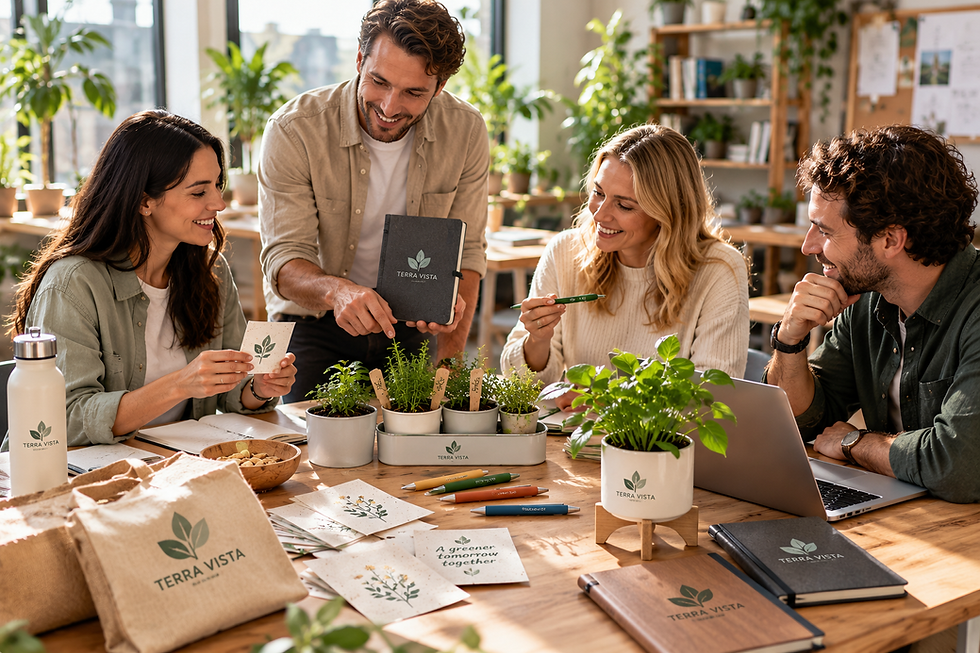
IF THIS WERE YOUR BRIEF
If you're looking for sustainable promotional products but don't want to fall back on the same options you've seen everywhere else, tell us what you're trying to achieve.
Give us your quantity, approximate budget, audience, deadline and what sustainability means to your organisation or campaign.
You don't need to decide whether you want recycled, seed paper, cork, cotton, bamboo, or something completely different before you contact us.
That's the part we can help narrow down.
With thousands of promotional products available, the goal isn't to show you every sustainable option.
It's to find the few that actually make sense for your brief.
And if you'd like to see how your branding could work before deciding, upload your artwork with your quote request, and we'll provide a free branded mock-up with your quote.
Because sustainable promotional products don't have to look predictable.
And neither does your brand.
👉 Explore our promotional products range today: www.merchandiseup.com.au


